How Long Should You Wear Compression Socks Each Day?
Most people wear compression socks during the day: on in the morning, before swelling builds, and off at bedtime. Unless your doctor tells you otherwise, you generally should not sleep in them, and it is fine to take them off for a break if they feel uncomfortable.
If you are new to compression, you can build up gradually over the first week or two. Here is what a typical day looks like, and the situations where your doctor may give different advice.

Mentioned in this article
-
-
-
A typical day in compression socks
Cleveland Clinic advises putting compression socks on in the morning, before swelling starts, and taking them off at bedtime. MedlinePlus suggests putting them on first thing, even before you get out of bed.
| Time | What to do |
|---|---|
| On waking | Put socks on while sitting on the bed, before you are up and about |
| During the day | Wear them while you are up, sitting or walking |
| Rest times | Keep them on, and raise your legs when you can |
| Evening | Take them off at bedtime, check your skin, wash the pair |
| Night | Sleep without them, unless your doctor says otherwise |
MedlinePlus also notes that you should follow your provider's instructions on how long each day to wear them. If your doctor has given you a schedule, use that.
Why morning is the best time to put them on
Overnight, while you lie flat, fluid that collected in your lower legs during the day has a chance to move. By morning, ankles are usually at their slimmest. As soon as you are upright, gravity starts working on the legs again.
Putting socks on before that happens has two benefits: the sock goes on much more easily over a slim ankle, and it supports your legs from the start of the day. Trying to pull a snug sock over an ankle that is already puffy is harder work and less comfortable.
Should you sleep in compression socks?
Generally, no. Cleveland Clinic advises against sleeping in compression socks, though a short nap in them is fine. When you lie down, your legs are level with your heart, so gravity is no longer pulling fluid toward your feet in the same way.
Taking socks off at night also gives your skin a break, lets you check for marks or sore spots, and gives you a chance to wash the pair.
There are exceptions. Some people are told by their doctor to wear compression at night for a specific reason. If your doctor has given you different instructions, follow them. For a better night, raising your legs on a pillow is a simple alternative.
Easing in if you are new to compression
The snug feeling takes some getting used to. Cleveland Clinic notes there can be an adjustment period, and that it is fine to take socks off if they are uncomfortable at first.
A gentle way to start:
- First few days: wear them for a few hours in the morning, when you are most active.
- Next few days: wear them until mid-afternoon.
- After a week or so: wear them from morning until bedtime, if they feel comfortable.
If you still find them uncomfortable after a couple of weeks, the size or level may be wrong. Measure again with our sizing guide, or try a lighter level. Our guide to choosing mmHg can help.
Taking breaks during the day
It is fine to take compression socks off for a while if you need to: to rest your skin, to bathe, or simply because they feel too warm. Cleveland Clinic notes that wearing them nonstop is not good for your skin.
If you take a break, try to raise your legs while the socks are off. If you put them back on, do it while sitting with your feet up for a few minutes first, so the ankle is not at its most swollen.
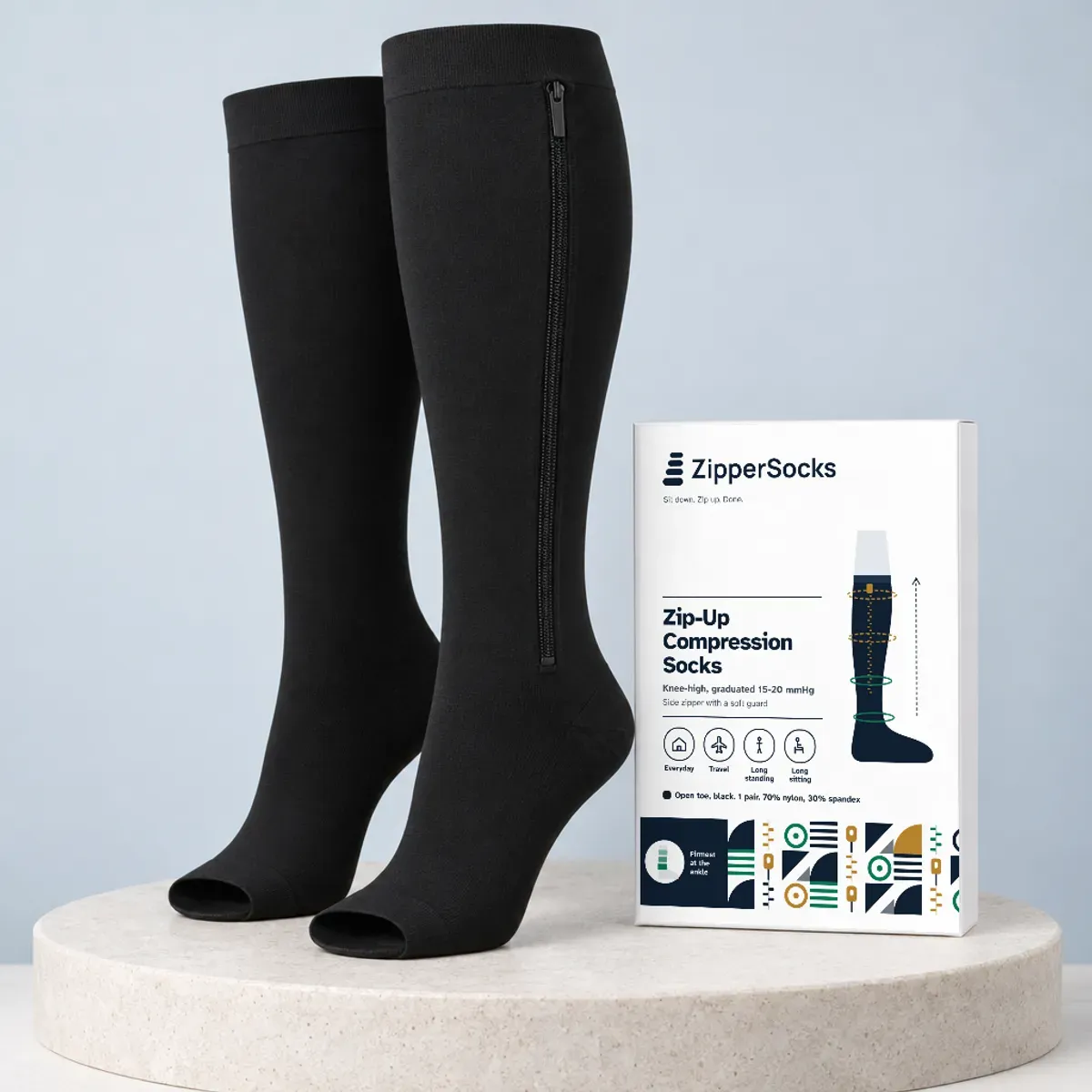
On a hot day, an open-toe style such as the ZipperSocks open-toe zipper socks, a brand we stock, can feel cooler, and a zipper makes it easy to take them off and put them back on.
Every day, or only some days?
That depends on why you wear them.
- For everyday tired legs and minor swelling, many people wear compression on most days, especially days with long periods of standing or sitting.
- For travel, people often wear them only on travel days. See our guide to compression socks for travel.
- If your doctor recommended compression for a condition, ask them how often to wear it. Some people are advised to wear compression every day for the long term.
Wearing them regularly means they wear out sooner. MedlinePlus suggests replacing compression stockings every 3 to 6 months, and having two pairs so you can wear one while the other is washed. Our washing guide has more on care.
Making all-day wear more comfortable
A few small habits make the difference between socks you tolerate and socks you forget you are wearing:
- Get the size right. A sock that digs in at the top or wrinkles at the ankle will feel worse every hour. Measure in the morning and compare with the chart.
- Smooth out wrinkles after you first sit down, especially at the ankle and behind the knee. MedlinePlus advises not letting stockings bunch up or wrinkle.
- Keep moving. Short walks during the day help your calf muscles, and the NHS suggests avoiding long periods of sitting or standing still.
- Raise your legs when you rest, on a footstool or the sofa.
- Look after your skin at night, with a gentle moisturizer once the socks are off, so it is not dry and itchy under the fabric the next day.
- Choose a level you can live with. A moderate sock worn all day is often more useful than a firm one that comes off by lunchtime.
Signs you should take them off
Cleveland Clinic advises removing compression socks and calling your provider if you have:
- Pain
- Numbness or tingling
- Skin discoloration, such as toes turning pale, blue or dusky
- Swelling that is getting worse
Also take them off and check your skin if you notice deep grooves, sore spots, blisters, or broken skin. A comfortable pair should feel snug, not painful.
A word of caution. Check with your doctor before wearing compression if you have peripheral artery disease, heart failure, fragile skin or open sores, or reduced feeling in your feet.